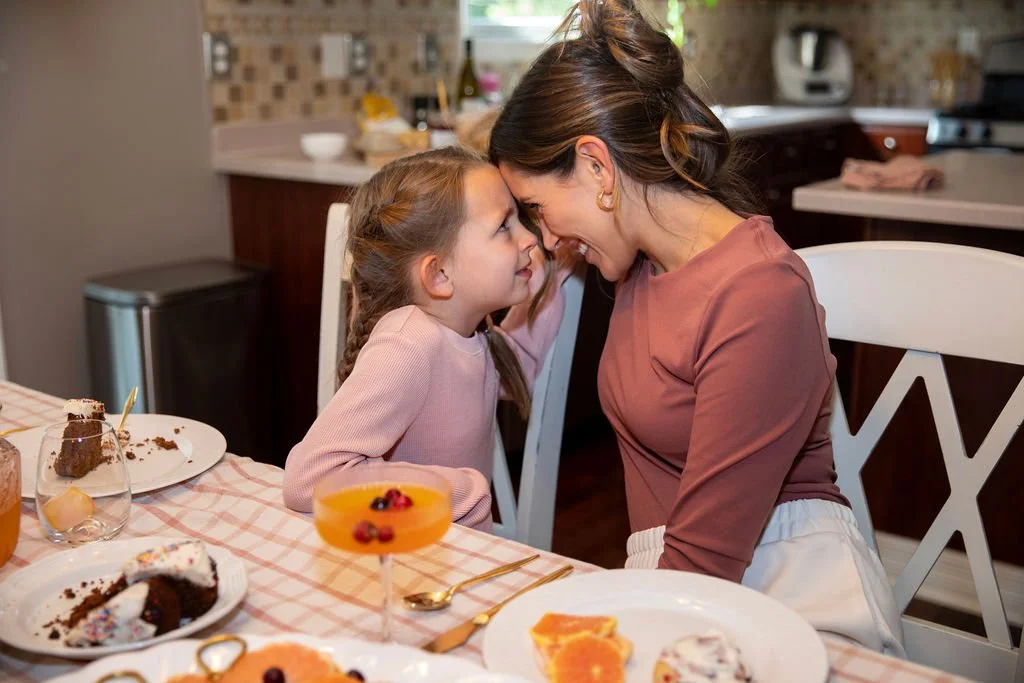
Table conversation & game
Practical family dinner prompt: ask a funny question that sparks your child’s imagination (for example, “If our mashed potatoes could talk, what would they say?”). Let everyone share one short answer. If you have time, after the meal invite your children to draw what they imagined while you do the dishes. Turn a rushed dinner into a meaningful connection—and a simple, creative end‑of‑day activity.
Practical family dinner prompt: ask a funny, imaginative question that sparks your child’s creativity. Let everyone take a turn and share one short answer.
I printed this, cut it out, and tucked the slips into a cute little box. Let your children decorate the box and then have each child choose one of the mystery dinner prompts once a week.
If your stuffed animals had jobs, what would they do?
Would you rather have spaghetti hair or waffle hands?
What’s the funniest sound you can make for a sneezing dragon?
If our family lived in a treehouse, what room would each person choose?
What animal would make the rudest waiter?
If you opened a restaurant for monsters, what would be on the menu?
What would happen if cats could text?
If you could invent a holiday tomorrow, what would everyone have to do?
Which vegetable is secretly plotting something?
If your shoes could talk, what would they complain about?
What would your superhero name be if it had to include a food?
If the moon were made of something besides cheese, what should it be?
What’s the silliest rule you could make for the house for one day?
If tiny elves lived in the fridge, what would they argue about?
Which animal would be best at hide-and-seek?
If pancakes could talk, what would they say while cooking?
What would your dream playground definitely include?
If you had a pet dinosaur, what chores could it help with?
What would happen if everyone floated instead of walked for one day?
Which family member would survive longest in a candy jungle?
A few easy dinner games too:
One-Word Story: Each person says one word at a time to build a ridiculous story.
Two Truths and One Silly Lie: “I ate a bug, I met a pirate, I can juggle flamingos.”
Sound Effect Challenge: Someone describes an activity using only sound effects.
Mystery Object: “If I shrank you to ant-size, what object in this house would become the scariest?”
And for kids those ages, “would you rather” questions usually hit especially well:
Would you rather burp bubbles or sneeze glitter?
Would you rather ride a giant hamster or a tiny elephant?
Would you rather only whisper or only sing for a whole day?
Would you rather have a robot chef or a robot bedtime storyteller?
If you have a few extra minutes after the meal, invite your children to draw what they imagined while you wash the dishes. It turns a rushed dinner into a purposeful moment of connection and gives them a calm, creative way to close the day.
Bedtime talks
What was the coziest part of your day?
If today had a color, what color would it be?
What’s one tiny thing that made you smile today?
If your bed could fly anywhere tonight, where would you want to wake up?
What animal do you think gives the best hugs?
What would your dream nighttime snack be in a fairy-tale world?
If stars could whisper, what do you think they’d say?
What kind of house would you build for a sleepy mouse?
If clouds were soft enough to sit on, what would you bring with you?
What sound helps you feel peaceful?
If you could keep one happy moment from today in a jar, which one would you pick?
What do you think the moon sees every night?
If your dreams had a doorway, what would it look like?
Which would you rather fall asleep beside: a waterfall, a fireplace, or gentle rain?
What would a dragon do on its day off?
If you had a lantern that glowed whenever someone was kind, when did it glow today?
What would your perfect reading nook include?
If animals tucked their kids into bed, how would they do it?
What do you think tomorrow is quietly excited about?
If you could send one happy thought floating into the sky tonight, what would it be?
A nice rhythm with younger kids is:
one silly question
one cozy/imaginative question
one “favorite part of today” question

Fruit of the spirit
Help children learn, reflect, and live out each Fruit of the Spirit—making faith practical and joyful.
Having chosen homeschooling for our family for the coming school year, I wanted to incorporate bible teaching. My children are currently not allowed to speak of our savior Jesus Christ on the school ground. This alone, created a fire in me to regain the control over their formation. Not just education, because truly my children have had incredible educator. People who truly cared for their academic growth. But in this world, I think we too often put that specific topic in too high of a pedestal. School teaches valuable topics, yes. But I want my kids to think of their growth on all levels. I want them to grow spiritually as well as academically. Most importantly, I want them to be kind, generous and giving human beings. I want them to comprehend but most importantly feel that the bible isn’t a shameful book, it is the truth about their existence: Not random, not the result of science but that they are intricate, unique and beautifully made for a bigger purpose then they can imagine. I need them to bath in this truth, all day. I want to regain all the hours with them to explore, to learn, to give, to play and to create. All day, every day.
Don’t read this wrong. This isn’t coming from a desire to control, it is the opposite. It is a desire to offer freedom for my children to develop their God giving talent before the world tells them to take a different path in order to be “successful in life”.
Each month we’ll focus on one Fruit of the Spirit. Learning, discussing, and putting it into practice. We’ll begin each session with conversation and prayer, study related Bible passages, and memorize key verses. Together we’ll turn what we learn into intentional actions that serve and strengthen our community and family bond.
Galatians 5:22–23! 🌿
Below is a complete, easy‑to‑use monthly guide designed for kindergarten through 4th grade, emphasizing simple teaching, hands‑on crafts, meaningful discussion, and community or service activities. I am a type B person and having this plan to follow will keep me organized and maybe will help you as well!
🌈 Overview
Goal: Help children learn, reflect, and live out each Fruit of the Spirit while making faith practical and joyful.
Structure:
1 fruit per month (September–May or any 9‑month cycle)
Each month includes:
Bible Verse + Teaching Focus
Discussion Ideas (for child understanding)
Hands‑on Craft & Activity
Community & Action Challenge
🍎 MONTHLY BREAKDOWN
Month 1: Love, (September 4us, can be any month!)
Verse: 1 Corinthians 13:4–7 or John 13:34
Teaching Focus: Love is showing kindness and care for others, even when it’s hard.
Discussion:
How can we show love in our day-to-day life?
What does love look like when someone is sad or angry?
Craft: Make a “Love in Action” poster — kids draw or write ways to show love (help a sibling, hug a friend, pray for someone).
Community Action: Send “We appreciate you” cards to neighbors, family, or essential workers.
Month 2: Joy, (October 4us, can be any month!)
Verse: Philippians 4:4 – “Rejoice in the Lord always!”
Teaching Focus: Joy comes from knowing God’s love, not from things we have.
Discussion:
What makes you happy? What gives you joy (a deeper feeling)?
Can we still have joy on a hard day?
Craft: Suspend paper airplanes or delicate leaves from the ceiling on thin, nearly invisible thread, each one bearing a word or short phrase naming something you’re grateful for. You could also make a “Joy Jar.” Choose a jar and decorate it together, then each week tuck in slips of paper noting happy moments, small wins, or simple blessings. I personally feel these wins should be displayed to see but I understand some prefer to keep a simple eastetic in the home.
Community Action: Bake cookies or treats and deliver them with smiles or drawings to cheer others.
Month 3: Peace, (November 4us, can be any month)
Verse: John 14:27 – “My peace I give you.”
Teaching Focus: Peace is calm inside even when things are noisy, scary, or hard.
Discussion:
How can we bring peace at home?
How does prayer help us find peace?
Craft: Make a “Peace Dove” or a handprint peace sign, with the scripture gently written inside. If time and interest allow, add simple centerpieces for Thanksgiving to complete the table. I know my kiddos love to help decorate for holidays, this can be a great way to include the teaching in the decor.
Community Action: Help your community church assemble Thanksgiving baskets for neighbors who can’t afford a holiday meal. Include a brief family prayer over each basket, asking that the household who receives it be comforted and filled with the Lord’s peace.
Month 4: Patience, (December 4us, can be any month!)
Verse: Psalm 37:7 – “Be still before the Lord and wait patiently for Him.”
Teaching Focus: Patience is waiting with a good attitude.
Discussion:
What makes it hard to wait?
What can we do while waiting?
Craft: Plant seeds in small cups. Each day, talk about waiting and watching God make things grow. Make a mosaic off of recycled pieces of plastic, showing that every random piece can create a piece of Art, God is the master of our lives. When we do not see His great plan and wish we could erase or “trash” old pieces, He uses them for transformation, so much is found in the waiting period. I highly encourage you to use a bible advent with your children, they are so fun to do once a day.
Community Action: Visit or video call grandparents or elders & listen patiently to their stories. I would love to set aside dedicated time for us to visit a retirement house.
Month 5: Kindness, (January 4us, can be any month!)
Verse: Ephesians 4:32 – “Be kind and compassionate to one another.”
Teaching Focus: Kindness is being friendly, helpful, and forgiving.
Discussion:
How does kindness change people?
What’s the nicest thing someone did for you?
Craft: Create “Kindness Rocks” paint rocks with positive words and place them in a park or along a trail.
Community Action: Do a “Kindness Week” challenge: one kind act per day (help a neighbor, share toys, write a nice note, etc.).
Month 6: Goodness (February 4us, can be any month!)
Verse: Galatians 6:9 – “Let us not grow weary of doing good.”
Teaching Focus: Goodness is choosing what’s right and pleasing to God.
Discussion:
Is it easy or hard to do good when others don’t?
How do we know what’s good?
Craft: Make a “Good Deed Tree” — add paper leaves each time your child does something good.
Community Action: Collect food for a local pantry or help a neighbor with yard work.
Month 7: Faithfulness (March 4us, can be any month!)
Verse: Proverbs 3:3–4 or Lamentations 3:22–23
Teaching Focus: Being faithful means keeping promises and trusting God.
Discussion:
What does it mean to be trustworthy?
How is God faithful to us?
Craft: Create a rainbow promise bracelet, colors remind kids of God’s promises.
Community Action: Care for a pet, plant, or small project daily to practice dependability.
Month 8: Gentleness (April 4us, can be any month!)
Verse: Philippians 4:5 – “Let your gentleness be evident to all.”
Teaching Focus: Gentleness is strength under control & being careful with words and actions.
Discussion:
What are gentle hands? Gentle words?
How can we handle anger gently?
Craft: Make “Gentle Hands” art. Trace hands and list ways they can be gentle.
Community Action: Volunteer at the human society with the pet. We can show gentleness to the creatures of Gods. I would love to volunteer in the baby section at church or take on babysitting for a family so that the parents can go on a date. Together we can show gentleness to all the family members.
Month 9: Self-Control (May 4us, can be any month!)
Verse: Proverbs 25:28 – “A person without self-control is like a city with broken walls.”
Teaching Focus: Self-control means making wise choices, even when we want something else.
Discussion:
When is it hard to have self-control?
Why does self-control protect us?
Craft: Make a “Stop & Pray” traffic light craft (Red – stop, Yellow – take a breath, Green – do what’s right).
Community Action: Plan a “No Complaining Day” or “Healthy Choices Week” as a family.
🌟 Tips for Parents / Teachers
Keep sessions simple: 20–30 minutes per day or a few focused days per month.
Use storybooks, songs, and Bible story videos for age-appropriate understanding.
Reinforce each fruit during family prayer or mealtime reflection.
End each month by celebrating with a “Fruit Feast” serve fruit and talk about what your child learned!